
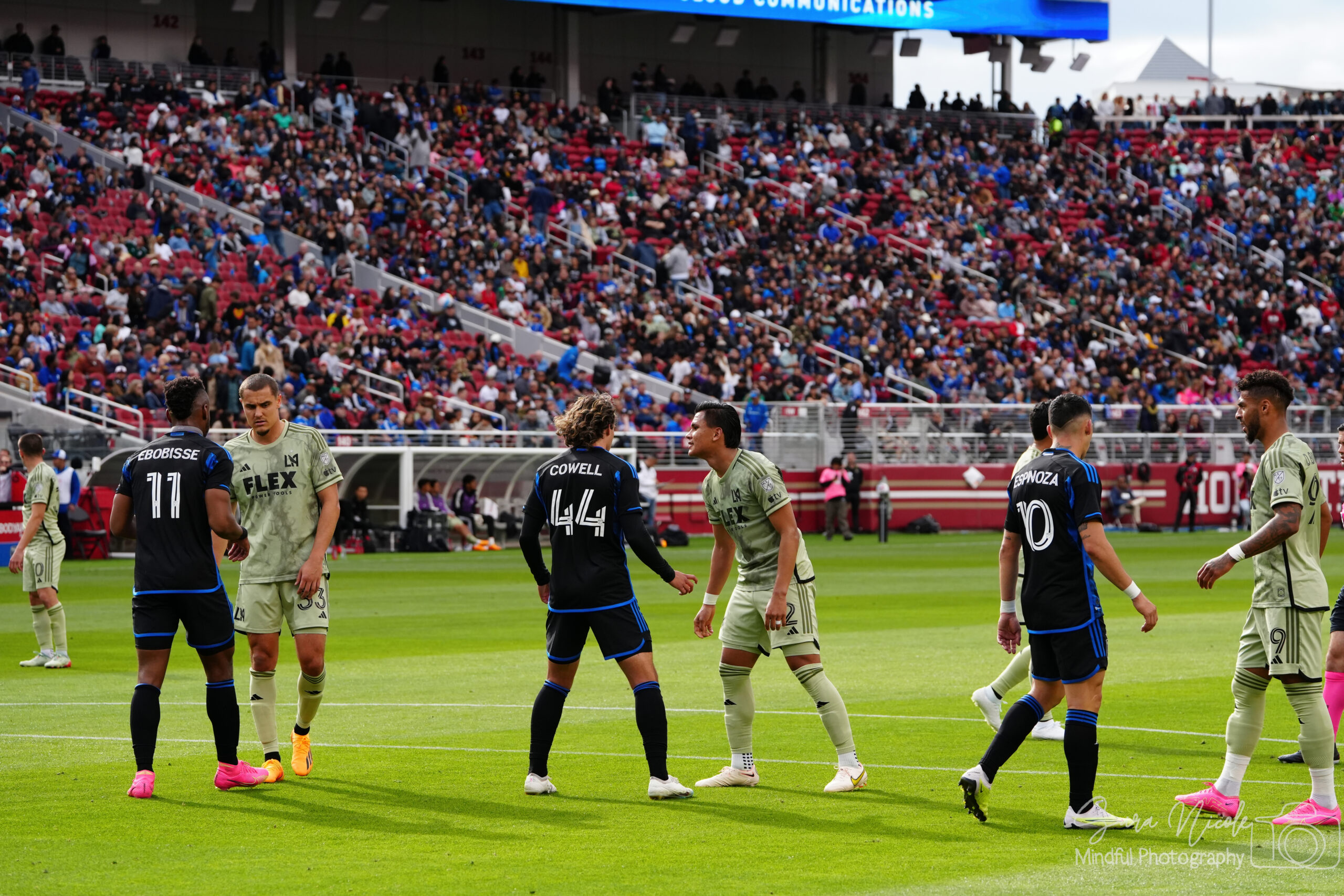
Young players aren’t just what get the fans excited – they’re the basis of successful roster building. And I’m worried the Quakes haven’t been getting it right in recent years, in no small part due to reliance on managers to call the roster shots.
Even across leagues that don’t have the bizarre types of salary restrictions that Major League Soccer does, I generally prefer a mode of roster building where you identify truly elite talent for large spending of resources, but otherwise rely on replacement-level players or young prospects on minimum salaries with high upside.
You could call it the “studs and duds” model, which is also a fun callback to a segment on Quakes After 90, a beloved Quakes-related podcast of yesteryear.
I think there are plenty of advantages of this model even in a league with a simple salary cap like the NFL: you pay market rate for elite, differentiated, hard-to-replace talent, and below-market-rate for rookies, but never spend market rate on undifferentiated players. The 49ers are famous for holding this model, for example. The main advantages are 1) greater likelihood of players’ value “exceeding” their salary in a salary-capped league and 2) greater opportunities for young players, who are the primary driver of that surplus value. Of course, the downside is that top-heavy rosters can be knocked off course more easily by injuries to key players, and in a more collective sport like soccer, lacking mid-level depth can be a bad thing too if your low-salary/young players are too far behind the curve.
But MLS actually makes this studs-and-duds even more attractive than in the NFL, with salary rules that explicitly favor bias towards “studs” (DP slots and TAM) and “duds” (young players, whether drafted or homegrown, frequently don’t touch the salary cap at all due to various advantages). If you look at most of the super-successful MLS teams of the last decade, their rosters tend to be top-heavy like Inter Miami or LA Galaxy.
Which brings me to the San Jose Earthquakes. Under Matías Almeyda, and now Bruce Arena, the manager has exercised major control over the roster. There are some advantages to that, but one major disadvantage is that managers have a much shorter time horizon they’re optimizing for than is ideal for club-building, particularly for low-budget clubs like San Jose. That means that when offered the choice between a middling player who has a fairly high floor for quality of play, but no further upside, and a young player who will certainly contribute less today but may have major upside tomorrow, a manager will frequently go for the former. That goes directly against the long-term interests of the club, who can only get the surplus value (more quality on the pitch for less money), in a salary capped league, by getting young players on rookie or homegrown contracts to perform.
Under Almeyda, there were numerous examples, but two glaring ones that stood out to me. First, when Almeyda was offered the choice of Andy Ríos on a large contract, or Danny Musovski on a very small one, he chose Ríos and passed on Musovski. This was an obviously catastrophic decision, since Musovski has developed into a much more significant contributor, and still hasn’t made as much money in the league (despite many more years played) than Ríos did. Of course, it’s entirely possible that rookie Musovski would not have been as “ready” for MLS-level play as Ríos, but only on the shortest time scales. And we had no way of knowing at the time that Musovski definitively was going to turn out – but the % chance that he would is still worth it.
Another slightly longer-term issue arose with Daniel Vega, who bumped homegrown JT Marcinkowski down the depth chart, and directly led to the club letting Drake Callender go to Miami for a relatively small fee. Marcinkowski was only about league-average when he was the starter, but Vega presented little improvement, and prevented us for taking advantage of Marcinkowski’s favorable salary treatment (as a homegrown player) and any potential further upside he might have had if he had more continued starter gametime. More importantly, it also caused the club to let Drake Callender go to Miami for very little. Callender, of course, has already spent three years as a starter there, and also had the favorable homegrown salary treatment.
Both Vega and Ríos, then, are examples of a manager preferring a middling player they know and trust to a player that was better for the long-term health of the club.
This isn’t specific to Almeyda, however. Bruce Arena, not even a year into his tenure, has engaged in the same instinct. He signed Nick Lima as a right back despite the fact that Oscar Verhoeven, a homegrown on a lower salary, was primed to step up to MLS-level. Lima hasn’t played much, but it put even more distance between Verhoeven and playing time, so the club allowed him to leave to San Diego, where he’s already made 11 starts. Sure, Arena still may have opted to go for DeJuan Jones to get a more impactful player in that role, but Lima’s signing remains indefensible for further burying a promising homegrown 18 year old.
Arena’s most recent acquisition, Ronaldo Vieira, commits the same sin. The player might end up valuable to the Quakes, he’s younger (at 27) than most of the above examples, and I do understand the reasoning – Arena only really has two central midfielders he trusts, with Mark-Anthony Kaye as the backup, which means the position is quite thin. But unless Noel Buck is out for an incredibly long time, you’re blocking his pathway to game time, and Buck is on a lower salary, plus U22 eligible, and is young enough to get potentially much better. That’s to say nothing of Cruz Medina and Niko Tsakiris, who may or may not fit what Arena wants from the position, but who certainly don’t need yet more players to compete with for game time. The chance that Nick Fernandez, even, has to be the next Beau Leroux is also taken away.
It’s not just managers who succumb to this temptation. The front office between Almeyda and Arena did sign the likes of Amahl Pellegrino, for example, for big money, despite having a local player on a smaller salary in Benji Kikanovic who could fulfill a similar role. They even had Ousseni Bouda as a slightly different player whose game time was likely impacted.
Conclusion
San Jose has made much better decisions at the top of their roster in recent years, like Josef Martínez and Chicho Arango. They’ve been quite good at drafting for the back end of their roster, as my previous article argues. They’re beginning to put together the bones of a successful “studs and duds” roster strategy.
So all I’m asking for is that given the team is not yet close to competing for major titles, please stop signing good-but-not-great 30somethings for big money to fill out the middle of the roster, particularly when there are young players whose pathways to game time are disrupted because of it.
I understand, these young players may struggle, the team in the short term may be worse because of it, and not all of them are going to work out the way we hoped. But as successful franchises across MLS (and other salary-capped sports) demonstrate, you need to give each one of these lottery tickets every chance to pan out or you’ll never get beyond the lower-middle-class of the league.


